“I get the words, but I can't picture it. So I end up scrolling reels instead.”
It's evening. Aarav has a chapter on the Harappan civilisation. The book shows a flat drawing of a city; he can't picture how the drains ran or why it mattered.
He reaches for his phone to look it up. Reels win. The chapter is still unread — and tomorrow he'll reread it, which feels like studying but rarely is.

7 interviews. 8 findings. One pattern: help has to start from the book.
Secondary research turned every finding into a design rule.
NCERT is scaling printing from 5 to 15 crore books a year.
DIKSHA put QR codes in thousands of textbooks — most lead to static videos and PDFs.
More teens use their phone for social media than for study.
CBSE is moving to competency-based questions; NEP 2020 asks for experiential learning.
Multimedia tied to the story aids comprehension; unrelated games distract. Quizzes beat re-reading.
Structured AI tutoring outperformed lectures; open chatbots invite copying.
Context is the product: AI helps because it knows where the reader is.
→ The QR tells the app the exact page.
Many formats, one source — they work when all point back to the same chapter.
→ Every mode is a lens on page 91.
Engagement isn't depth: summaries let people skip the book.
→ Every session ends back on the page.
Across all three, trust came from boundaries — spoiler limits, citations, answers only from the source. So in PadhPlay, “Ask the book” cites the page and the figure.
Everyone else is either tied to the book or interactive. Not both.
| Feature | DIKSHA 2.5 / 8 | Coaching apps 3 / 8 | ChatGPT / Gemini 1.5 / 8 | NotebookLM 3 / 8 | Learn Your Way 3 / 8 | Kindle 2.5 / 8 | PadhPlay 8 / 8 |
|---|---|---|---|---|---|---|---|
| Starts from the printed book | |||||||
| Knows the exact page | |||||||
| Stays within NCERT | |||||||
| Guides before it answers | |||||||
| Many modes, not just text | |||||||
| Cites the page it used | |||||||
| Rewards understanding, not minutes | |||||||
| Ends back on the book |
● core · ◐ partial · ○ missing. Assessment from public product information, Oct 2026. Hover a column to compare.
A student uses it. A dozen other groups decide whether it ever reaches them.
High power, high interest. Co-design with them.
High power, low interest. Consult and comply.
Low power, high interest. Share progress.
Low power, low interest. Watch for changes.
Hints first, the answer one tap away
Short sessions that end on the page
Every answer cites the page
XP for understanding, not minutes
NCERT's terms bar using its books in software without written permission. Ask first.
Under-18s need verifiable parental consent, with no tracking or targeted ads.
Adoption runs through schools. DIKSHA already prints QR codes — show what PadhPlay adds.
Positions are judgement calls. Sources: NCERT copyright notices, DIKSHA and PM eVidya (PIB), DPDP Rules 2025 commentary.
We ranked every idea with RICE — and then argued with the ranking.
RICE = Reach × Impact × Confidence ÷ Effort. Lime = in the proof of concept. Scores are assumptions, not measurements.
“See it happen”, the narrated animated scene, ranks near the bottom on effort — but it's the one feature that carries the infotainment brief. We kept it on purpose and said so.
AR on the diagram scored 0.83 — the lowest of all. A QR at key concepts scored 14.4, the highest, and rides on a habit students already have from DIKSHA. AR moved to “what's next”.
Six ways in. One way out: back to the page.
How should a student get from the printed page into PadhPlay?


Let the student pick how to learn — six ways, one concept.

Make history talk back — with citations.


Reward marks, not screen time — and end on the page.

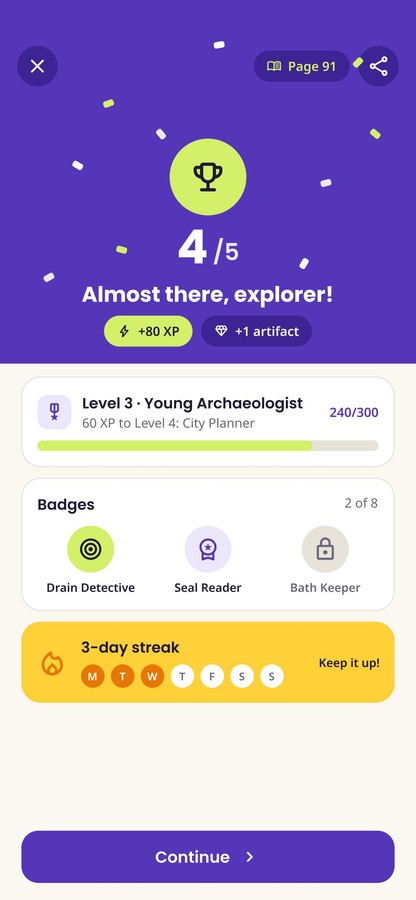

Every session returns to the printed page.
The outcomes below are intended, not measured. They're what our usability study will test.
Questions after every concept
3D models show how things work
Hints and revision adapt to you
Every session ends on the page